
Demand to shift 1.65-km rail stretch in Hoolongapar to protect endangered ape
The demand to prevent wildlife fatalities comes after a critically endangered western hoolock gibbon died of electrocution
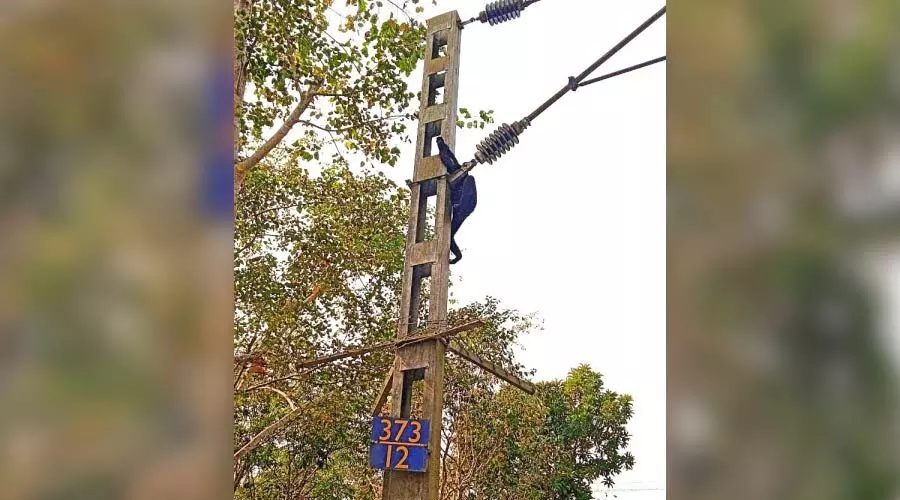
Recent electrification of the railway track without putting in place mitigation measures has heightened the danger manifold (AT Image)
Guwahati, Feb 15: Expressing serious concern over the death of a critically-endangered western hoolock gibbon which died of electrocution on the railway track inside Hoolongapar Gibbon Wildlife Sanctuary (HGWS), Kaziranga Wildlife Society has called for immediate rerouting of the train track to prevent wildlife fatalities on the track.
“Kaziranga Wildlife Society sincerely appeals to the authorities concerned to take up the diversion works of this small section of the railway track and this should be treated as a priority project.
At the same, the Government of India should arrange necessary right of way for the diversion of 1.65-km railway track, from Hoolock Gibbon Wildlife Sanctuary,” KWS said in a statement.
While the train track that cuts through the heart of one of Assam’s most biologically diverse wildlife habitats, recent electrification of the tracks has enhanced the hazard for arboreal species like the gibbon – also the sanctuary’s flagship species.
Conservationists point out that rerouting the train track to make it bypass the sanctuary should not be much of a problem because it is only a 1.65-km track that bifurcates the small 20.98-sq km sanctuary into two halves.
“Because of their arboreal and branchiation (swinging movement from branch to branch) behaviour, electrifications of the railway track has become a death trap to the gibbons which also happens to be India’s only ape species.
The bifurcation of the sanctuary by the railway track poses danger to other territorial wildlife, mainly elephants. Railways could have easily bypassed this small section of the track, if they were really concerned about conservation of wildlife,” KWS said.
It is apprehended that, KWS added, the tracks will be converted to double tracks in the near future which will totally defy the very basic purpose of wildlife protection of a wildlife sanctuary.
“It seems that our State authorities as well as State representatives to the Parliament have least concern about such type of violations of WPI Act, 1972 by an agency like the Indian Railways,” KWS said.
As per 2023 census, there are 125 numbers of hoolock gibbons in 26 groups (they live in monogamous family units of three to six with mated pair plus offspring).
Populations of the western hoolock gibbon have declined by almost 90% over the last 30 years, and it is now considered to be one of the most endangered 25 primate species in the world with total population are less than 5,000.
The dissection of the sanctuary by the railway track “created” two isolated forest island, raising a serious risk of weakening the gene pool of the primates.