
'Decades of neglect ended after 2014': MP Suklabaidya on tea garden reforms
Calling tea a lifeline for thousands, Suklabaidya flags shift from indifference to focused policy
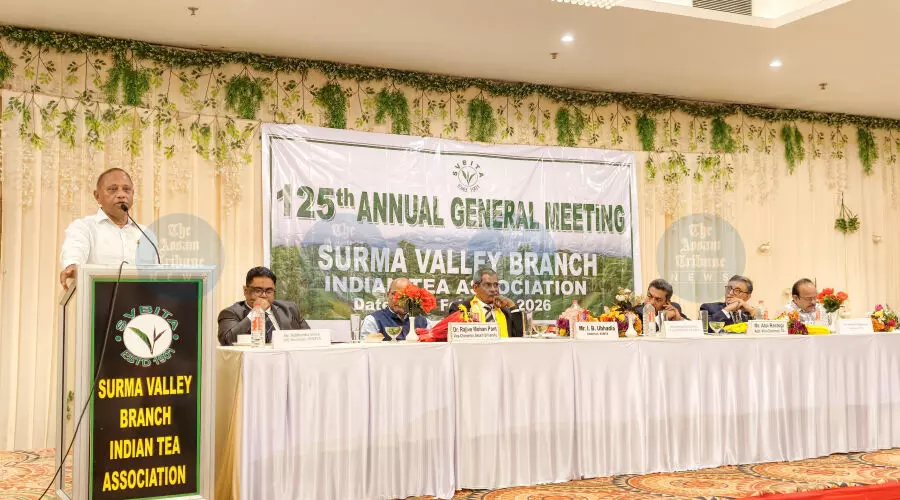
Suklabaidya addressing that Annual General Meeting of SVBITA. (AT Photo)
Silchar, Feb 23: Structural challenges confronting the tea industry in southern Assam took centre stage at the 125th Annual General Meeting of the Surma Valley Branch of the Indian Tea Association (SVBITA), where industry leaders and policymakers called for urgent corrective measures to safeguard competitiveness and credibility.
Addressing the gathering, MP Parimal Suklabaidya launched a political broadside at the Indian National Congress, alleging decades of neglect of the tea garden community prior to 2014.
He asserted that the BJP-led governments at the Centre since 2014 and in Assam since 2016 have prioritised infrastructure, healthcare, wage reforms, housing and food security for tea workers.
The MP cited improvements in rail connectivity, road corridors and airport infrastructure, stating that enhanced logistics have bolstered the tea industry’s export potential.
He also referred to welfare measures such as mobile medical units and health coverage under Ayushman Bharat, which provides eligible families with treatment benefits of up to Rs 5 lakh.
Emphasising that tea is more than an export commodity and remains a livelihood backbone for thousands, Suklabaidya described the current approach as a decisive shift from what he termed “decades of indifference” to focused governance.
In his presidential address, SVBITA chairman Ishwar Bhai Ubhadiya pointed to a paradox in India’s tea trade.
While exports touched 280.40 million kg in 2025, generating earnings of Rs 8,488 crore, nearly 40 million kg comprised low-cost imported teas that were blended and re-exported.
He underscored the need to protect the integrity of the “India origin” label through stricter quality enforcement and sourcing norms.
Turning to the Barak Valley, Ubhadiya said the region produces around 37 million kg of tea annually, roughly 6.5% of Assam’s total output, but remains hamstrung by structural disadvantages.
Planters face a location-linked transport cost burden of nearly Rs 4 per kg, alongside recurring power disruptions, fertiliser supply bottlenecks and escalating input costs.
He noted that worker wages have risen by nearly 140% between 2015 and 2025, describing the increase as morally justified.
However, he stressed the need for balanced sustainability through productivity enhancement, mechanisation, scientific cost management and fair price realisation.
With global markets tightening pesticide residue norms, Ubhadiya urged strict spray discipline and adoption of integrated pest management practices to protect export prospects.
Aligning with Prime Minister Narendra Modi’s “From Chai to Chips” vision, he advocated greater adoption of technology, including AI-driven precision agriculture, digital soil mapping and satellite-based crop forecasting, to mitigate climate variability and labour shortages.
The milestone 125th AGM reflected both concern and resolve, signalling the gravity of structural pressures facing southern Assam’s tea economy while underscoring a shared commitment from industry and government to secure a resilient future.