
Concerns emerge over Assam govt’s move to make Nellie massacre report public
'People are living in harmony in the greater Nellie area, tabling of the report may destabilise the prevailing peace and trust among communities,' says LOP Debabrata Saikia.
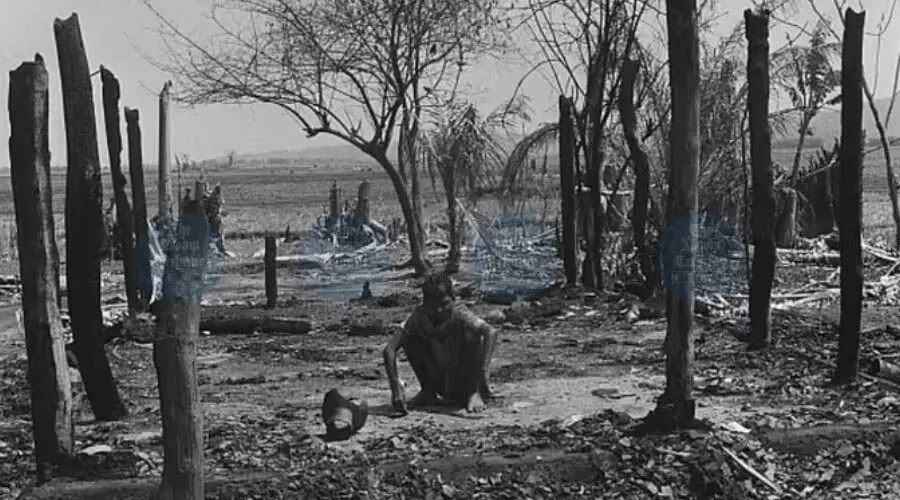
A file image of Nellie Massacre
Guwahati, Oct 26: Two days after the Assam government announced plans to make public the Tiwari Commission Report on the Nellie massacre of 1983, a cross-section of people on Saturday voiced apprehension that the move could jeopardise peace among communities.
Chief Minister Himanta Biswa Sarma had on Thursday told reporters that the State Cabinet decided to table the Tiwari Commission Report in the next assembly session in November.
During the Assam Agitation from 1979 to 1985 against infiltration, over 2,100 people were butchered, mostly Muslims, in a single night in the infamous Nellie massacre of 1983.
“I don’t understand why such an old report will be made public after almost 43 years of the incident. When the wounds have already healed, why scratch those now? Is it being done to instigate people ahead of the assembly elections?” Leader of the Opposition Debabrata Saikia said.
He said when people are living in harmony in the greater Nellie area, tabling of the report may destabilise the prevailing peace and trust among communities.
“It seems the CM is frustrated with people of all castes and religions uniting after Zubeen Garg’s death. People from all communities are demanding justice for him and showing allegiance to Garg’s ideology, which was against communalism,” Saikia said.
Nellie (in Morigaon district) is a cluster of around 16 villages. On February 18, 1983, Assamese Hindus and indigenous tribal neighbours attacked the villages and killed over 2,100 people in a span of about six hours.
The attacked residents primarily belonged to the Bengali-speaking Muslim community whose predecessors had migrated from former East Bengal from as early as the 1930s.
On July 14, 1983, the Assam government had set up a commission under the leadership of TP Tiwari. The 551-page report was submitted to the erstwhile Hiteswar Saikia government in May 1984, but never tabled or made public.
Parthajit Baruah, who made a full-length feature film on the massacre – The Nellie Story – opined that bringing out the report at a time when the entire State is grieving Garg’s death is “surprising and disappointing”.
“The time is not conducive now. The people are emotionally broken. We expect the government to unearth the truth behind Garg’s death in the first place,” he said.
Baruah also said that tabling and discussing the Tiwari report is likely to divert the entire attention from Garg’s case.
“There is another aspect. Against the popular notion of killing only Bengali Muslims in the massacre, many tribal locals also died in the incident in the Raha area. I have shown that angle in my film, which surprisingly was not discussed in society,” he said.
As per a research paper ‘Denying the Animosity: Understanding Narratives of Harmony from the Nellie Massacre, 1983’ by Jabeen Yasmeen of IIT Bombay, the carnage was one of the worst mass-killings in post-Independent India.
“It is debatable whether the Nellie massacre should be referred to as a massacre and not a genocide... it should rather be named a genocide due to the assailants’ intent to wipe out a certain community,” she said.
Pallavi Deka, an assistant professor of political science in Handique Girls’ College here, said the Nellie massacre is an event in history that is still relevant in Assam politics.
“This decision is an offshoot of that relevance. Seeing the turn of events after Garg’s death and the decision to make the report public needs to be analysed together,” she said.
Deka said the current government is “trying to reap the maximum out of it is obvious”, given the timing of the planned tabling of the report.
Defending the decision, Chief Minister Sarma had said that the document was not tabled so far because the copy with the Assam government did not have the signature of the chairman.
“We didn’t know whether the copy we have is actual. So, we interviewed the officials and clerks of that period who were involved in the report. The document was also sent to forensics for verification. When it was authenticated, we decided to make it public as people have the right to know what had happened and whose fault it was,” he said.
Apparently supporting the government, All Assam Students’ Union (AASU) president Utpal Sarma said that it was wrong to keep such an important document under wraps for such a long period.
“It was a commission formed by the government. So, why successive governments didn’t table it is a big question. We will also not allow the demand for justice to Garg to get diverted because of this report,” he asserted.
Following the Nellie massacre, a total of 688 cases were filed. The police submitted chargesheets for 310 cases. When the Assam Accord was signed in 1985, the perpetrators were given total impunity – a major aspect that indicated denial of the gruesome incident.
Yasmeen, in her paper, wrote: “Despite prevailing tensions and warnings from senior police officials, (assembly) elections were held on February 14 and 17, 1983. The leaders of the Assam Movement called people to boycott the elections.
“While most of Assamese society abstained from voting, a section of the Bengali-speaking Muslim minority voted, which enraged the Assam Movement leaders. The participation by a section of the Bengali-speaking Muslim minority is believed to have led to the massacre,” she added.
The research paper also cited various scholars and claimed the local Lalung (Tiwa) tribe and other scheduled caste Hindus in and around Nellie were provoked to believe that the land abandoned by the Bengali-speaking Muslims would become theirs after the massacre.
– PTI