
Brahmaputra’s July discharge falls to 17,000 cumec, sparks fears over channel stability
Last year, the flow discharge of the mighty river at Pandu was around 38,000 cumec in the month of July.
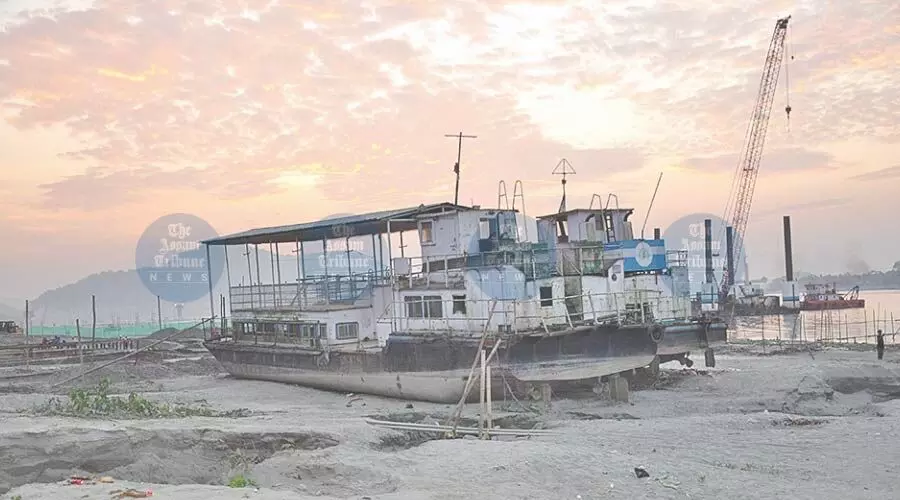
Guwahati, Aug 13: River discharge of the Brahmaputra depleted quite uncharacteristically this year, which may lead to detrimental consequences to fluvial geomorphology for upsetting channel stability, flood carrying capacity, and aquatic ecosystem sustenance.
Talking to The Assam Tribune, internationally acclaimed river expert, Prof Nayan Sharma, a former professor of IIT Roorkee and currently Professor of Excellence in Gauhati University, said that the maximum discharge of Brahmaputra at Pandu was recorded as 72,779 cubic meters per second (cumec) in August 1962, and on several occasions the river discharge exceeded the 70,000 cumec mark. That is why, the new extradosed bridge connecting Guwahati with North Guwahati has been designed for a discharge of 81,000 cumec.
Last year, the flow discharge of the mighty river at Pandu was around 38,000 cumec in the month of July.
This year, the discharge very significantly depleted to less than half to about 17,000 cumec in the same month. The highest water level in July last year was 48.34 meters in Guwahati and it came down to 46.22 meters in this year July.
Quoting Indian Meteorological Department (IMD), he said Assam recorded 44 per cent rainfall deficit this year till end of July 2025. Notably, IMD has made a forecast for below normal rainfall for Northeast India during August 2025, even as rest of the country overall is expected to receive above normal showers in the second half of the South-West monsoon season.
He further pointed out, presently neutral El Niño–Southern Oscillation (ENSO) conditions are prevailing in the equatorial eastern Pacific Ocean, and the Indian Ocean Dipole (IOD) is expected to turn weakly negative towards the end of the monsoon, both of which may unfavourably influence rainfall distribution in the Northeastern India.
The above forecast comes amid ongoing concerns in Assam and other Northeastern states over erratic rainfall this monsoon, with official warning of possible moisture stress on crops, tea gardens, and water resources if the rain deficit persists, he said.
Prof Sharma said, studies estimate snowmelt contributes anywhere from 6 per cent to 21 per cent of the Brahmaputra River’s total annual flow and the rest of the discharge originates from rains within India. Poor monsoon in the Northeast may be the prime reason for the depleted river discharge of the Brahmaputra this year. While, other parts of the country received very good rainfall, the Northeast region faced deficit rainfall, due to effects of dominant climate episodes.
The construction activity for the Super Mega Dam on the Great Bend Canyon of the Yarlung Tsangpoby China, officially launched on July 19 last, may likely to cause in future some stream flow disruption in lean season due to possible river flow diversion for the dam building. But that may not be the reason for the present depleted discharge in the Brahmaputra, said Prof Sharma.
Prof Sharma said the Brahmaputra River is one of the most sediment-laden rivers globally. When the flood discharge is adequate, the flow has requisite stream power to carry bulk of incoming sediments away to the sea. With the present depleted discharge as prevailing now, the river may lack the required stream power to carry forward the bulk of incoming sediments, which is likely to cause siltation in river bed in random irregular heaps. Obviously, the river bed would rise unevenly – leading to depleted flow carrying capacity as well as to generate erosive currents by their regular sediment heaps. In that case, after heavy rains later, devastation may be more pronounced due to inefficient channel hydraulics to curtail desired flood carrying capacity, he added.Depleted Brahmaputra flood discharge, if prevails for long may cause harmful channel morphology changes.
This may manifest in heightened braiding behaviour when undesired multiple secondary channels may get formed as in case of acutely braided Gumi-Sualkuchi reach, said Prof Sharma. Now, in the remaining season, if the South West Monsoon fails to bring in the adequate rainfall, the threat of bank erosion may likely to heighten at vulnerable sites when the high flow starts receding, Prof Sharma warned.