
Assam’s services employment share drops to 30.1%: Niti Aayog report
Female participation in services stands at only 15.1%, Niti Aayog suggests leveraging tourism in Kaziranga and Majuli
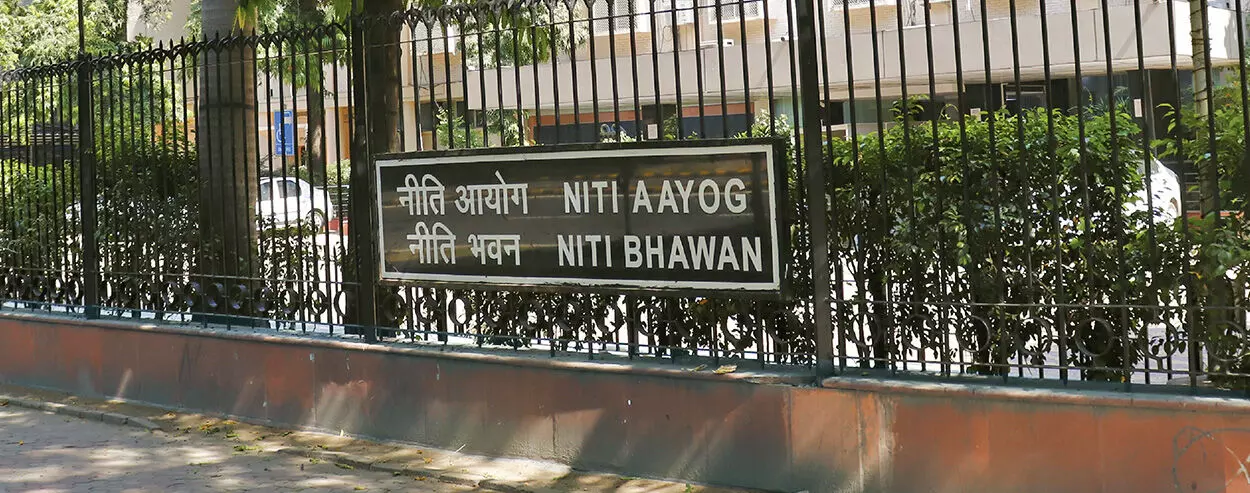
A file image of NITI Aayog (Photo: niti.gov.in)
Guwahati, Nov 1: The share of workforce employed in the services sector in Assam declined over the last decade, according to a Niti Aayog report.
“As of 2023-24, 30.1 per cent of Assam’s workforce (5.1 million workers) was employed in the services sector, a slight decline from 30.7 per cent in 2011-12. Nevertheless, this remains marginally above the national average of 29.7 per cent,” stated the report titled ‘India’s Services Sector: Insights from Employment Trends and State level Dynamics’.
Chandigarh (77.9 per cent), Delhi (71.0 per cent), Goa (59.1 per cent), and Puducherry (59.6 per cent) remain the most service-oriented economies. These shares have been consistently high since 2011-12, reflecting their urban nature and dependence on professional services, public administration, and tourism, it stated.
In the Northeast, Mizoram (49.6 per cent) and Nagaland (43.1 per cent) report higher-than-average services shares, while others such as Sikkim (43.8 per cent) and Arunachal Pradesh (26.2 per cent) are closer to the national mean.
The highest chunk of workforce in Assam continues to be in the agriculture sector (47.2), followed by construction (13 per cent) and manufacturing (9.3 per cent).
Moreover, percentage of the workforce in services sector in rural areas of Assam is as low as 25.8 per cent, the same in urban areas is 71 per cent. Female workforce in the sector is just 15.1 per cent.
Within the services sector in the State, employment share is highest in wholesale and retail trade (41.7 per cent), followed by transportation and storage (18.8 per cent), education (13 per cent) and accommodation (6.4 per cent).
“To expand employment opportunities, there is a need to encourage more cultural events and develop creative hubs for arts, crafts and media, thereby promoting local culture and generating jobs in event management, hospitality and the creative sector,” the report suggested.
It also suggested leveraging of tourism and eco-based services in Kaziranga and Majuli for rural youth employment, besides expediting the multi-modal logistic park to enhance regional connectivity and reduce logistics costs.
Services employment in India varies significantly across states and UTs, reflecting differences in economic structure, urbanisation, and sectoral diversification.
Uttar Pradesh has the largest number of service workers (22.1 million in 2023-24), despite a relatively low share (22.7 per cent). Maharashtra follows closely with 21.5 million workers (36.2 per cent), supported by its large urban base. West Bengal (15.7 million, 32.5 per cent), Tamil Nadu (13.5 million, 37.9 per cent), and Gujarat (10.5 million, 30.2 per cent) also make major contributions.
Kerala (48.5 per cent, 7.5 million) and Andhra Pradesh (31.8 per cent, 7.8 million) display strong reliance on services, driven by healthcare, education, and trade.