
Assam polls: Distance dilutes democracy as outstation voters miss out on voice
High airfares, 50-hour train journeys and work constraints keep thousands of young Assamese voters away this election season
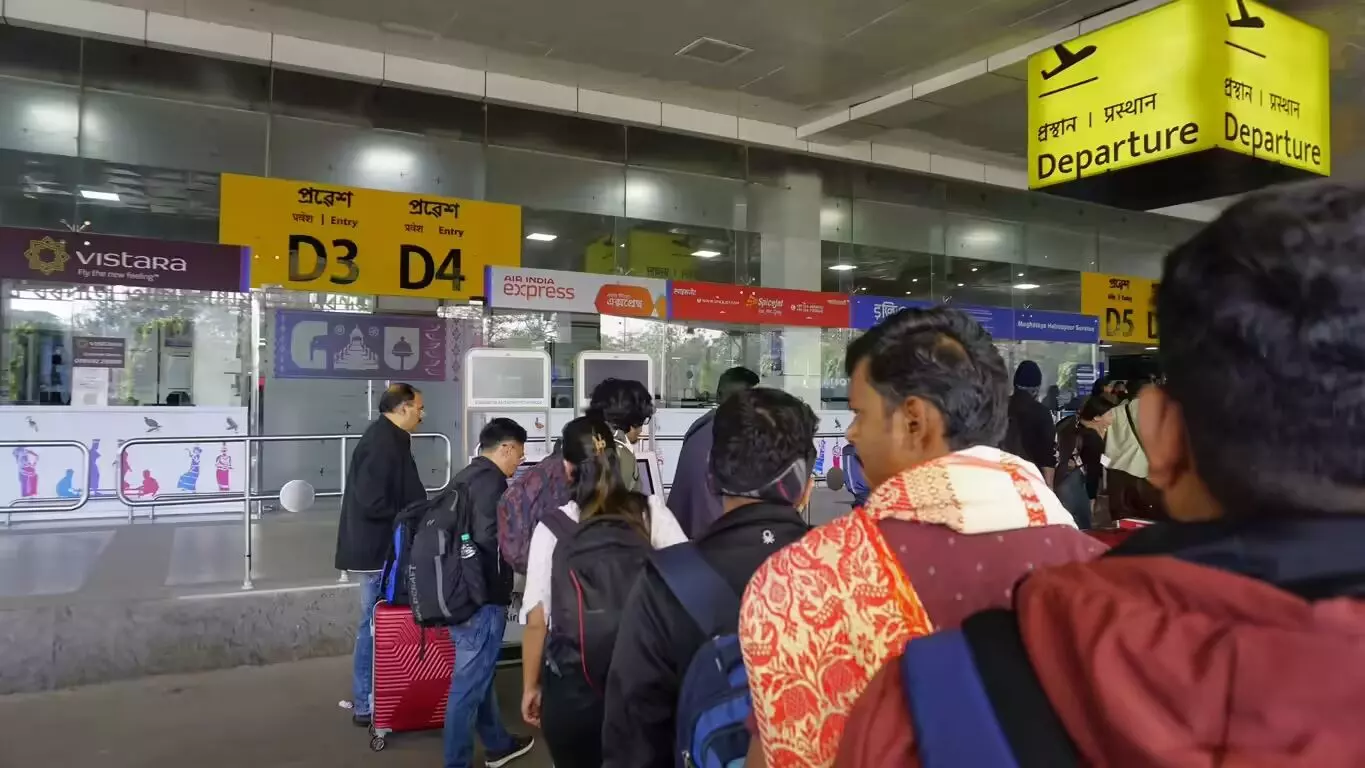
Representative image of travellers making departure from an airport (Photo: Alarmy)
It is a celebration of democracy in Assam as the state heads to its 15th Assembly elections on April 9. But for a significant section of the Assamese diaspora across India and abroad, the moment carries a quiet sense of longing.
Drawn away by education, employment and opportunity, many find themselves unable to return home to cast their vote.
This absence is not merely statistical. At a time when young voters constitute a substantial share of the electorate (72.83 lakh), their inability to participate reflects a deeper structural gap, one that intersects with questions of accessibility, representation and the realities of migration in a rapidly changing society.
“Not being able to return home and vote often feels limiting, especially when you know that every single vote matters. Being unable to do so can feel like being excluded from shaping the future of a place that has shaped you,” said Mumbai-based Akansha Khound.
Khound described the experience as one marked by “pride, concern and a sense of distance”, adding that living away has only sharpened her political awareness.
“Distance hasn’t meant disengagement. If anything, it has made many of us more vocal about what we want for Assam, better governance, stronger institutions and policies that truly serve people,” she said.
Yet, for most outstation voters, intent is rarely the issue, logistics are. Bastab Tapan Bordoloi, a 24-year-old who recently moved from Jorhat to Mumbai, recalled how different elections felt when he was back home.
“There were discussions at home, conversations in the locality, elections were visible everywhere. Here, there is a disconnect,” he said.
Having voted in previous elections, Bordoloi said missing out this time feels like losing a role in the democratic process. “I know what it feels like to vote. So, when I can’t, it feels like I am missing out, even if it’s just one vote,” he said.
Representative file image of voting through an Electronic Voting Machine (Photo: PTI)
Votes lost to distance
But returning home is easier said than done. Respondents flagged that flights during the election period, often coinciding with Bihu, are prohibitively expensive, while train journeys can take over 50 hours one way.
Add to this the need for nearly a week off work, along with ongoing airspace curbs following the West Asia conflict, and the idea becomes impractical for many young professionals. “It’s not about willingness. It’s about how manageable it is in real life,” Bordoloi said.
Echoing these concerns, a social media user who goes by the name Khar_Singh on Meta highlighted the financial and physical risks involved in travelling home to vote.
Addressing Assam Chief Minister Himanta Biswa Sarma in an Instagram video, the user said he would be unable to vote this time due to the high cost of travel and difficulty in securing train tickets.
He pointed out that for migrants with average-paying jobs, booking flights during the election season could amount to nearly one and a half months’ salary.
In a pointed appeal, he urged the government to facilitate special train services from major cities to Assam during elections, noting that many voters face similar constraints that often go unnoticed by those within the state.
The same sentiment is echoed in Bengaluru, where Bhaswati Borthakur described a growing disconnect between voters and the political discourse. “The election atmosphere often feels more theatrical than substantive,” she said, noting that large rallies and surface-level rivalries tend to dominate narratives over real issues.
At the same time, she pointed to a deeper frustration. “We had hoped to travel home to vote, but the early schedule and short notice make it difficult and expensive. It feels like missing the chance to participate in shaping our state’s future,” she said.
For some, this exclusion has been long-standing.
Surangana Goswami, 23, has never cast her vote despite being eligible for years. Having moved to Bangalore for studies and now work, she has consistently been away from her designated polling station.
“It’s a recurring feeling of missing out, what we call Fear of Missing Out (FOMO). Voting is the most direct way to express our opinion. Missing that repeatedly feels like losing a part of our civic responsibility,” she said.
While most are aware of provisions such as postal ballots, they point out that these are limited to specific categories like government officials and armed forces personnel, effectively excluding students and private sector professionals.
“Even if such systems exist, they don’t really help someone like me. For us, voting still depends entirely on being physically present,” Bordoloi said.
File image of training ahead of elections in Assam's Margherita LAC (Photo: X)
Demand for remote voting
For many, the solution lies not in intent but in innovation. Respondents consistently called for more flexible voting mechanisms, ranging from authorised voting centres in other cities to secure remote or digital systems.
“Even a basic option to vote from another city would help a lot,” Bordoloi suggested. Others were more direct in their demand for reform.
“I would prefer remote digital voting. It must ensure transparency, security, and that the vote reaches exactly where it should,” said Goswami, stressing the need for strict safeguards.
Borthakur echoed the feasibility argument. “With the digital infrastructure we have today, a secure remote voting system is very much possible,” he said.
At the same time, trust remains a critical factor. “I would be open to remote voting,” Bordoloi said, adding, “but only if security and transparency are properly handled.”
Despite differing views on the method, the message from outstation voters is clear and consistent - the right to vote should not be restricted by geography.
Now, as Assam stands at the cusp of another electoral cycle, thousands of young Assamese voters watch from afar. The voices of its outstation youth are growing louder, not in protest, but in appeal. They are not disengaged, nor indifferent. They are simply unable.