
Assam govt splits Inland Waterways directorate, employees fear privatization
Assam’s IWT overhaul includes asset transfer, fare hike on Umananda route & leasing of Rs 305-crore Guwahati terminal
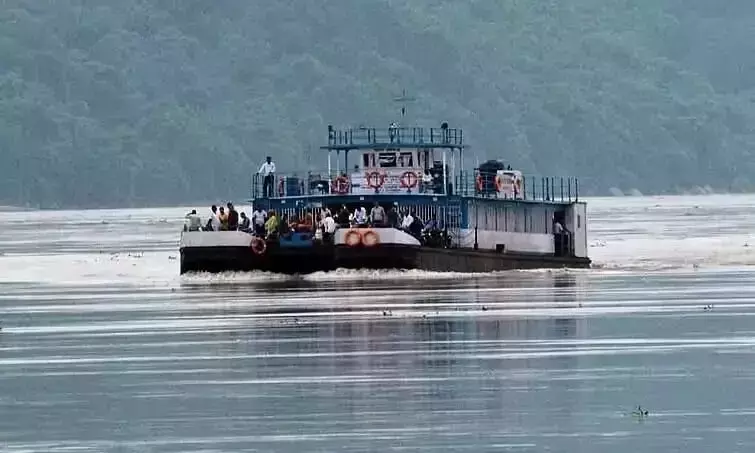
A ferry plying on a river (Representational Image)
Guwahati, Feb 17: The Assam government has quietly rolled out the process of “unbundling” of the 68-year-old Inland Waterways Transport (IWT) directorate, sparking fears that it would eventually pave the way for privatization of the sector.
A notification has been already issued directing transfer of all the fixed and floating assets of the IWT – including the vessels – to the Assam Inland Waterways Company Limited, an entity with limited manpower.
A Cabinet decision was also taken to bifurcate the directorate into two entities – the company and a regulatory body.
The company meanwhile floated a tender for leasing out the new Guwahati terminal built at a cost of Rs 305 crore, which was inaugurated recently.
Sources said an agreement with a Guwahati-based firm that participated in the tender process is likely to be signed soon.
Also, with effect from December 7, fares on the Umananda route – which was being operated by the company but with staff from IWT since 2023-24 – was hiked from Rs 40 to Rs 100.
A government notification has also re-designated the post of IWT Director as ‘Managing Director of Assam Inland Waterways Company Limited’.
In a separate notification, the government has constituted a four-member committee to examine, consider, and recommend the attachment and deployment of officers and staff of the Directorate of Inland Water Transport, Assam, to various organisations.
The committee is headed by the Additional Secretary, Transport Department.
It will also assess the manpower requirement of the company and the Assam Inland Water Transport Regulatory Authority for the discharge of its statutory functions, keeping in view roles, jurisdictions, and operational needs.
Around 2,600 employees of the directorate are now jittery, and apprehensive about job security, noting that there has been no clarity from the government so far.
In fact, they are contemplating legal resource. A majority of the employees are lower grade staff and on muster roll, with only around 300 in the Grade III and above category.
A one-man commission headed by Jitesh Khosla, formed after the Dhubri ferry disaster in 2012, had suggested a host of reforms to modernize the sector, which included separation of the regulatory and the operation wings.
To strengthen the inland waterways sectors, the government is also implementing a Rs 700-crore World Bank-funded project, under which the gateway terminal came up.
Sources said among the components of the World Bank project is unbundling of the directorate into separate entities for service regulation and operation to improve efficiency.
The residual functions were supposed to be kept with the directorate, employees were told.
Employees allege that there has been no clarity on the unbundling process, and details have been kept under wraps.
“A ship broke down recently, and is awaiting repair as there is no clarity on the responsibilities in this transition phase. Of late there has been much confusion among the staff,” sources said.
The government pumps in around Rs 200 crore into the directorate every year – around Rs 7-8 crore for fuel and Rs 2 crore for repair works. The directorate earns around Rs 10 crore revenue annually.
“The ferry services are public service like education and health. The commercial feasibility of a company operating them without manifold increase in the fares is slim.
The government has said it would fund the company only for five years and after that it will have to be self-sustaining. As new bridges are coming up, the regular ferry services would remain limited to certain areas,” the sources pointed out.
Employees also apprehend that all the ghats in the State are likely to be leased out phase-wise, and complete privatization of the sector is imminent in near future.
The IWT operates around 220 ferries in the State.