
Assam govt scraps two-child policy for tea tribes, Morans, & Motoks for govt jobs
The government decided to exempt tribals, tea tribes, Morans, and Motoks citing the need to preserve their identities and prevent population decline.
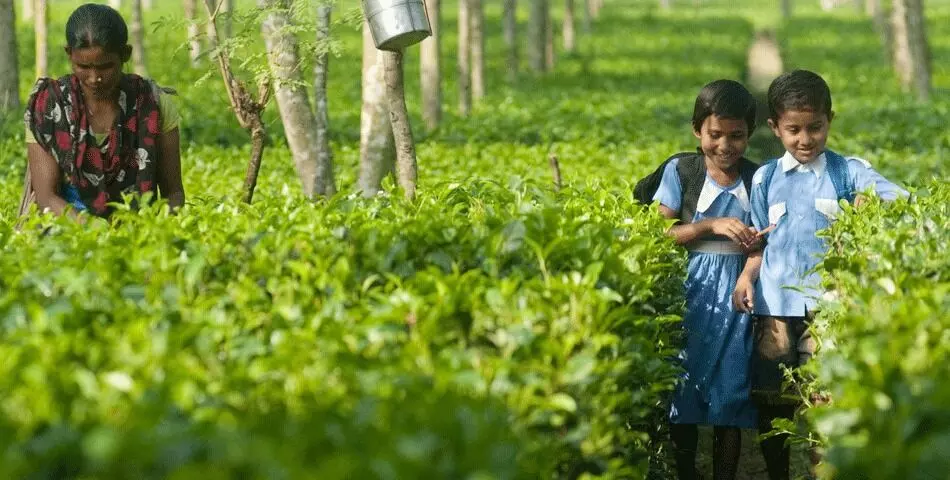
Guwahati, October 24: In a significant policy shift aimed at protecting indigenous and micro communities from demographic decline, the Assam Government on Thursday decided to scrap the two-child norm for members of the tribal, tea tribe, Moran, and Motok communities with respect to eligibility for government jobs.
Announcing the decision after chairing a Cabinet meeting in Dispur, Chief Minister Himanta Biswa Sarma said the exemption was necessary to safeguard these smaller communities from extinction and to ensure their cultural survival.
“The cabinet decided to exempt members of the tea tribes, Morans, Motoks, and Scheduled Tribes from the provision of restricting the number of children to two under the population policy. If we stick to the policy, these populations will lose their distinct identities and gradually become extinct in the next 50 years,” Sarma said.
The Chief Minister added that the Moran community, one of Assam’s oldest ethnic groups, currently has an estimated population of only around one lakh. He said the government had consulted social scientists before taking this decision.
“After studying demographic trends, it was found that the survival of these micro communities would be at risk if the two-child policy continued to apply. Hence, the cabinet resolved to lift the restriction,” he explained.
The two-child policy was earlier introduced under the Assam Public Services (Application of Small Family Norms in Direct Recruitment) Rules, 2019, and came into force in January 2021. The rule bars individuals with more than two children from being eligible for state government jobs.
It was also extended to panchayat elections through an amendment to the Assam Panchayat Act, 1994, in 2018, which made it mandatory for candidates to meet the two-child criterion, have minimum educational qualifications, and possess functional sanitary toilets.
Chief Minister Sarma recalled that in September 2021, shortly after the BJP government returned to power, the state had already waived the two-child policy for Scheduled Castes (SC), Scheduled Tribes (ST), and other traditional forest-dwelling communities with respect to government employment. Thursday’s cabinet decision formally includes Morans, Motoks, and tea tribes in that exemption list.
Sarma said the move was part of a broader commitment to protect Assam’s indigenous heritage and ensure equitable representation in state services.
“Our goal is not just population control but social preservation. These communities have contributed immensely to Assam’s identity, and their existence must be protected,” he stated.
Apart from the population policy decision, the Chief Minister announced that the government would table the long-awaited Tiwari Commission Report on the 1983 Nellie Massacre in the upcoming Assam Assembly session in November.
The report, he said, had not been presented earlier because the version held by the government lacked the chairman’s signature. “We interviewed officials involved in the original report and sent the document for forensic verification. The verified version will now be tabled before the Assembly,” he informed.
Referring to the massacre, which occurred during the Assam Agitation (1979–1985) and resulted in the deaths of over 2,100 people, mostly Muslims, in a single night in Nellie (now in Morigaon district), Sarma said the government aims to bring closure by making the findings public after four decades.
The Cabinet also approved a new bill to grant land rights to tea tribe communities, marking a landmark move in Assam’s socio-economic development.
“If we amend the land ceiling law, 2.9 lakh bighas—nearly 96,000 acres—of land can be distributed among 4 lakh tea tribe families. After 75 years of independence, this will remain one of our biggest social justice initiatives,” Sarma declared.
In another key decision, the Cabinet approved a cost escalation for the Assam Petro-Chemicals Ltd. (APL) project, increasing its total project outlay from Rs 1,709.18 crore to Rs 2,267.22 crore.
The revised estimate includes an additional state equity contribution for the 500 TPD Methanol Plant and 200 TPD Formalin Unit, both critical components of the state’s industrial expansion plan.
PTI