
Asom Sahitya Sabha seeks primacy for Assamese in governance on Mother Language Day
The organisation called for stronger steps to protect mother tongue learning & strengthen grassroots education
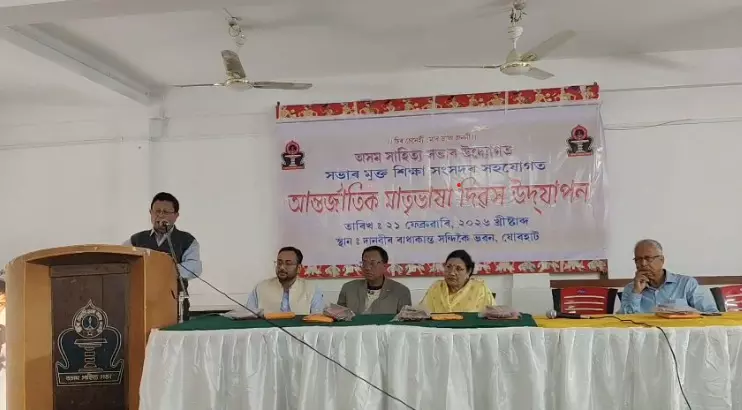
The organisation called for stronger steps to protect mother tongue learning and strengthen grassroots education.
Jorhat, Feb 21: Marking International Mother Language Day, the Asom Sahitya Sabha, on Saturday, expressed deep concern, claiming a decline in the use of Assamese in administration and education, while also drawing attention to the deteriorating condition of primary education in the state.
At Radhakanta Handique Bhawan, the Sabha’s headquarters in Jorhat, the day was marked with a discussion session focusing on the status of the Assamese language and the challenges facing mother tongue-based education.
Speaking at the event, Sabha president Basanta Kumar Goswami said Assamese should have been given primacy rather than being placed on equal footing with English, adding that the decision has largely remained on paper, with English continuing to dominate official communication.
On April 15, 2025, a decision was announced stating that Assamese would be used alongside English in government offices.
"It was declared that Assamese would be used along with English. But we believe Assamese should take precedence. Even that limited decision has not been properly implemented,” he said, adding that the Sabha has submitted a memorandum to the government in this regard.
Highlighting administrative challenges, Goswami noted that most official correspondence from the Assam Secretariat to district and sub-divisional offices continues to be issued in English. He also raised concern over the lack of Assamese-speaking and computer-literate staff in government offices.
“For example, in the Jorhat Commissioner’s office, there are only four staff members capable of working in Assamese on computers,” he added.
He stressed that unless government offices adopt the language in daily functioning, efforts to preserve and promote Assamese will remain ineffective.
“We request the government to provide training and infrastructure so that newly recruited typists and employees can type and function in Assamese,” he said.
Turning to the education sector, Goswami expressed concern over the state of primary education, saying that the system was much stronger between the 1960s and 1990s when emphasis was placed on language, grammar, and overall learning.
“Earlier, primary education in Assam gave importance to Assamese, grammar, English, and proper communication. Now, education has become job-oriented, with English being taught only as a tool for employment rather than for knowledge,” he said.
He further highlighted that 2,865 primary schools in Assam are currently functioning with only a single teacher, which has severely affected the quality of education. According to him, the frequent deployment of teachers for non-academic duties has worsened the situation.
The discussion session concluded with participants stressing the need for stronger policy implementation and a greater use of Assamese in administration.