
As Nijut Moina widens, PG students ask if it’s enough for Guwahati’s soaring costs
With 3.5 lakh beneficiaries this year, the scheme’s promise rises, but PG students still face stubborn city costs
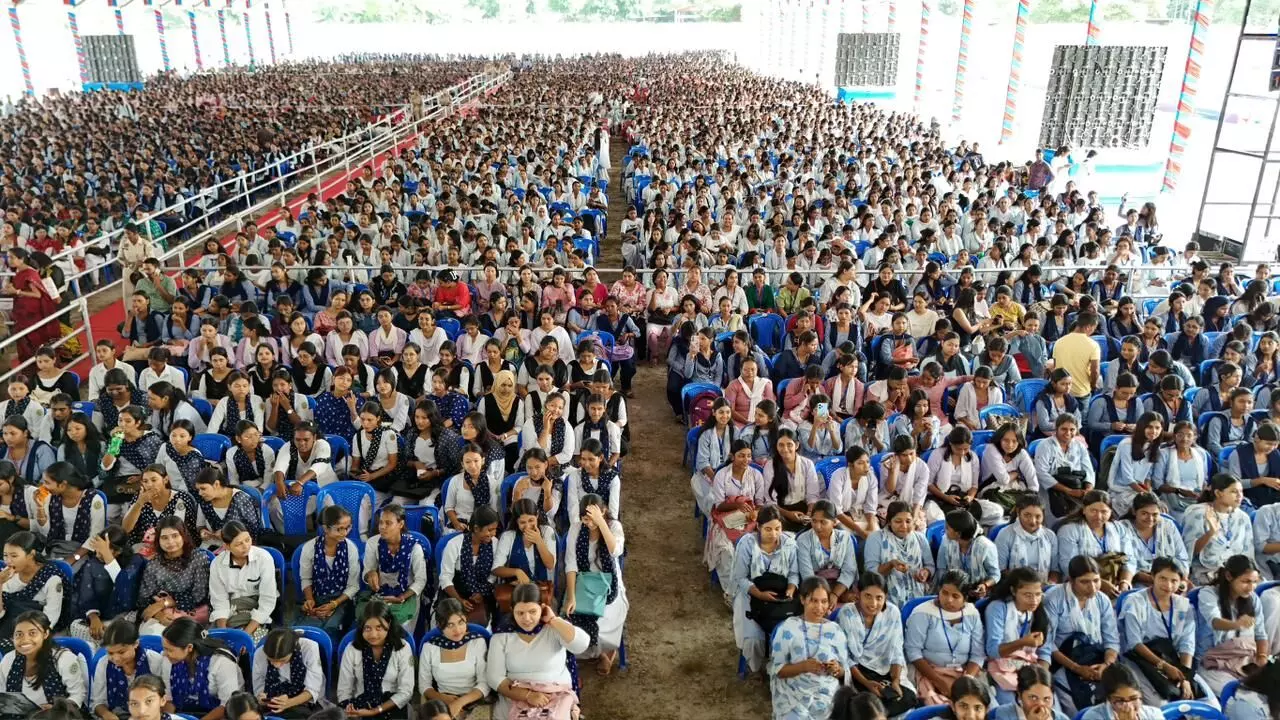
Assam college students attending a mass event (Photo:@CMOfficeAssam/X)
Assam government's flagship scheme aimed at empowering girl students in the state through financial assistance, recently brought over 3.5 lakh beneficiaries under its fold.
The scheme, aimed at curbing instances of child marriage and improves girl students' education, aims to expand to 10 lakh girl students in the coming years and has been getting good response from the beneficiaries.
Chief Minister Himanata Biswa Sarma recently said that the state has recorded no dropout among girl students in higher secondary, undergraduate or postgraduate courses over the past year.
Under the scheme, monthly financial assistance are provided to girls enrolled in Class 11, Undergraduate (BA/B.Sc./B.Com), Postgraduate (MA/M.Sc./M.Com/B.Ed), and technical courses like polytechnic and ITI.
For Class 11 students, the assistance is Rs 1,000 per month; for first-year undergraduate students, Rs 1,250 per month; and for first-year postgraduate or B.Ed students, Rs 2,500 per month.
A file image of CM Sarma distributing cheque to a girl student under the Nijut Moina Scheme. (Photo:@Habib_M_C/X)
It is, undeniably, an ambitious pledge, not just to ease educational expenses, but to reinforce that higher education is both achievable and worth pursuing.
Yet, a question lingers - in a growing urban centre like Guwahati, where living costs rise by the month, is Rs 2,500 enough to sustain a postgraduate student?
For PG scholars, unlike those in higher secondary or undergraduate courses who may still live at home, day-to-day survival in the city often becomes a far tougher challenge.
Against this backdrop, The Assam Tribune spoke to postgraduate students to gauge whether the Nijut Moina scheme is actually helping them pursue their studies and fulfil the government’s stated goals.
‘For us, every rupee counts’
For many young women who leave their hometowns for Guwahati, the city’s rising costs define their academic journey as much as their coursework does.
Mousumi Barman, an Anthropology student at Gauhati University, knows this well. Her father drives an auto-rickshaw and her mother works as a cook in a government school, and every extra expense must be justified.
“My parents said it’s a good initiative and encouraged me to apply,” she says, folding the stipend into a budget that must stretch across transport, practical materials and department needs.
Others arrived with similar caution. Barasha Kalita, pursuing her MSc in Mathematics at Cotton University, grew up aware that her family’s fluctuating income meant Guwahati would require discipline.
“My parents appreciated the government’s support. Even a little help matters,” she says. Her rent alone eats up a significant part of her monthly expenses, leaving the stipend to cover only the essentials.
When she recently collected her cheque, she chose to hold on to it until she returns to Nalbari, treating it with the care of someone who knows exactly what that sum means at home. “It’s something we must handle carefully,” she explains.
For students living far from home, the scheme sometimes feels like a quiet assurance rather than a full cushion. Parismita Borah, an M.Com student of Gauhati Commerce College from Jorhat, uses hers for seminar fees, project work and small but steady academic costs.
Her parents, she says, were relieved when she told them the government would help. “My parents felt good because I stay far away and expenses are high,” she says.
She is also candid about something many hesitate to articulate. “I think boys should also get this scheme. They also face hardships. If not full, at least half the amount should be granted.”
Short on funds, long on hope
Across campuses, awareness about Nijut Moina is universal; students know the eligibility criteria, the amounts, and the timelines. The challenge, however, is not information but affordability. Every student admits that Rs 2,500 cannot sustain a postgraduate life in Guwahati.
Rent, meals, transport, books, equipment, course requirements; the arithmetic simply does not balance. Yet the stipend remains an anchor. It reduces the pressure on families who already stretch every rupee, especially in middle-class and lower-income homes where a daughter’s education is often held together by determination more than resources.
Mousumi puts it simply, “Students in private colleges, who come from weak financial backgrounds, also struggle. They should not be excluded.”
Her observation speaks to a wider truth that economic hardship does not observe institutional boundaries.
Nijut Moina does not remove the financial weight students carry. But it does shift it slightly, giving young women a little more room to study, breathe and continue.
In a city where the cost of living grows with every passing year, that small shift can be the difference between staying enrolled and stepping back.
The scheme may not close the gap between need and reality. But for many daughters of Assam, it keeps that gap from widening and sometimes, that is what keeps their education alive.