
Aquatourism blooms in Kamrup as ponds, organic farms attract domestic, global visitors
Pioneers like Navajyoti Das & Gayatri Bhuyan are redefining rural tourism through aquatourism
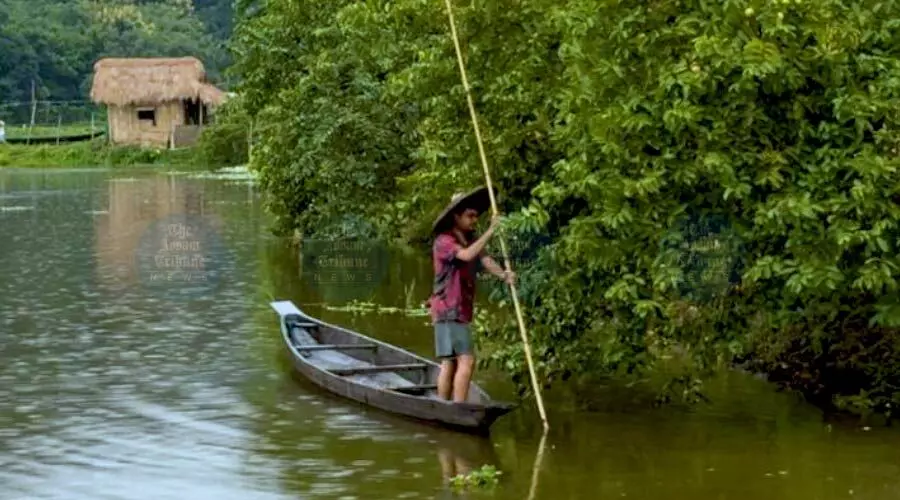
A man rowing wooden boat (Photo: AT)
Amingaon, Oct 20: Fish-based ecotourism, or aquatourism, is gaining ground in Kamrup district as some people have come forward to give a fillip to the tourism sector and initiated aquatourism centres in different parts of Kamrup.
Arts graduate Navajyoti Das of Bamunidi Hathimura near Hajo, a pioneer in this initiative, has established the Hathimura Eco Camp and Farming near the Hathimura Hills. Situated in Silguri, 30 km from Amingaon, the farm spreads over about 50 bighas of land. He has built cottages on the bank of the ponds, mainly from bamboo and locally available materials. Visitors to the farm who are interested in angling are provided with rods and lines to fish in the ponds, and preparation is afoot to erect more cottages near the ponds. Besides having 11 ponds of different sizes for fish rearing, there are also poultry and dairy units in Das’s organic farm.
“I charge of Rs 1,200 from a single angler for the period from dawn to dusk. The angler/tourist is provided with two fishing rods. The angler is allowed to carry home whatever fish is caught,” said Das, a best fish farmer awardee by the State government in 2023.
Starting as fish farmer in 2006, Navajyoti has developed his farm on what was once an inaccessible wasteland. “An idea of capitalising on the aesthetic appeal of the landscape located on the foothills crossed my mind, so I started this venture to supplement my income. Tourists from the Northeastern states flock to my site for angling and also demand accommodation facilities,” said Das, adding that angling activities spiked after the COVID-19 pandemic.
Meanwhile, the watershed moment for Navajyoti was his participation in an 11-day study tour to Cambodia and Vietnam. The tour was conducted under an Indo-German development cooperation project on food security through integrated aquaculture, known as Sustainable Aquaculture for Food and Livelihood.
“The concept was already in my mind but my exposure to the systematic project boosted my confidence to expand my aquaculture to aquatourism,” Das said. One more highlight of this venture is the showcasing of the muga and eri rearing art. “This culture is inextricably linked to rural life and I want to display it here for the tourists,” Das said. “I want to accommodate the local community engaged in this traditional activity of eri-muga rearing as a stakeholder as the site is near Sualkuchi, which will help the tourists to experience the full cycle from raw material stage to the finished textile stage,” Das informed.
Similarly, there is a blend of recreation, learning, and conservation in a sustainable setting in the Amaraboty Farm of Gondhmow near Sualkuchi. This site has become a hub for educational and experimental visits as students make a beeline to the farm to enjoy the experience of being in the lap of Nature. Owner Gayatri Bhuyan said, “Our pond, initially earmarked for pisciculture since 1968, is connected with the Brahmaputra which makes the site stunning for both ecotourism and aquatourism. Blessed with Nature’s bounty, we have made it springboard for aquatourism.”
“This farm offers practical learning in ecology, culture, and sustainability. Sighting of butterflies, migratory birds and ducks is a treat for the eyes,” she said, adding that they charge extra money for any fish caught using traditional bamboo rods and then taken home by the tourists, besides a charge of Rs 500 for the day.
She further informed that there are some professional anglers, particularly from South India, who release their catch into the pond. There is also a facility to cook the fish caught by the anglers, if desired.
Meanwhile, Debojit Choudhury, a progressive farmer with three decades of experience in the fishery sector, said that aquatourism has great prospects when it comes to generating employment. Notably, after a brief hiatus, Choudhury is all set to resume an aquatourism venture in more than 5 bighas of land that has several ponds. A hub of local vegetables, rich with natural and organic farming, the site is visited by tourists from countries like the USA, Germany, Italy, Canada, Spain, Japan, etc., who are allowed to pluck vegetables for consumption. Choudhury said that the tourists have a penchant for indigenous dishes, including local fishes and crab.
Urging upon people to tap the aquatourism potential of wetlands and derelict water bodies, Sanjay Sarma, district fishery development officer of Kamrup, said that such water bodies offer a range of recreational activities and hence they have great potential to attract tourists.
“Aquatourism is an upcoming avenue for resource generation. Assam being a hub of floodplain wetlands, we have a great opportunity to capitalise on these resources as attractive tourist spots,” Sarma commented, adding that water-based sports like fishing, angling, swimming, boating, rafting, etc., are also favourite activities of tourists.
“Once we can offer them such facilities, the rural economy will thrive and benefit the local youth,” he said.