
Amid grief for Zubeen Garg, potters in Nalbari battle high costs & heavy hearts
Amid the mounting challenges, the artisans have made a heartfelt appeal to the Assam government for practical assistance
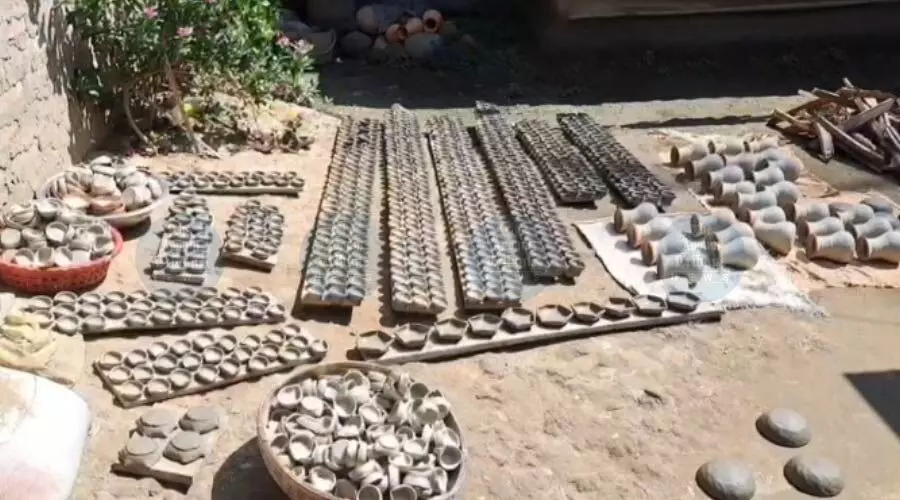
Earthen lamps arranged under the sun to dry in Nalbari (AT Image)
Nalbari, Oct 16: As the festival of lights draws near, the rhythmic hum of potter’s wheels fills the air across Nalbari’s villages.
With just three days to go for Diwali, the state’s traditional potters, known as kumhars, are working tirelessly day and night, shaping thousands of earthen lamps that will illuminate homes across Assam.
In Bahjani’s Sariya village, the sight is bittersweet. While the women sit by the wheels shaping the delicate lamps, the men load them onto cycles and trucks, bound for local markets.
“This year, we have already made about 15,000 to 20,000 clay lamps. Half of them are sold, but we don’t get a fair price for our hard work. We continue doing this because it’s our family tradition. Even if the earnings are low, this is how we earn our sustenance and keep our art alive,” said Anjana Das, a potter who has been crafting earthen lamps since she was twelve.
However, this year’s festive spirit feels unusually subdued. For many, this Diwali marks the first without beloved cultural icon Zubeen Garg, whose sudden death has cast a shadow of grief over Assam.
“Everyone is in sorrow because of Zubeen's death,” said Anjana. “The sales are not as good as before, but we have to continue. We must work to survive.”
Despite the emotional heaviness, work continues. The potters of Nalbari are racing against time, crafting and sun-drying thousands of diyas in the open fields.
Yet, unpredictable weather poses constant challenges. “If it rains, the whole lot of lamps gets drenched and goes to waste,” said Anjana, adding that a single spell of rain can wipe out weeks of hard labour.
The artisans source their clay from Ajanthuri near Amingaon in Guwahati, mixing it carefully with local soil before shaping it into lamps. The process is both labour-intensive and costly.
“We have to hire trucks or tractors to bring the clay, spending nearly Rs 5,000 per trip. Sometimes, five people work all night to dig the clay and stay for two days at the site,” explained another potter, Rongila, who has been making earthen lamps for decades.
“The expenses are high with transport, raw materials and food, but we still don’t get a fair return", Rongila said.
For every 100 clay lamps, the artisans receive just around Rs 80 from wholesalers, while in markets, a single lamp sells for Rs 1.
“There is no permanent market for us. We take our goods to Nalbari town or nearby markets in Hajo, Rangia and Barpeta, but the prices hardly cover our costs,” said another local craftsman.
Amid the mounting challenges, the artisans have made a heartfelt appeal to the Assam government for practical assistance.
“During the rainy season, we face a lot of loss. The prepared lamps are often destroyed by rain. We urgently need tin sheets to protect our work. If the government could provide at least 8 to 10 sheets per workshop, it would be a great help,” said a senior artisan from Chariya village.
Responding to their plea, Minister Jayanta Mallabaruah recently urged each artisan workshop to provide details for support and called for the supply of tin sheets to help preserve their work during monsoons.
Even as grief lingers and challenges mount, the potters of Nalbari continue their craft and not merely for livelihood, but to uphold a legacy passed down through generations.
“This Diwali may feel dampened,” said Anjana softly, as she placed another freshly molded lamp to dry, “but as long as our hands can spin the wheel, the light of tradition will not fade.”