
AGP grapples with internal pressure as BJP calls NDA seat deal final in Assam
Party president Atul Bora has suggested that discussions with BJP were still continuing, indicating that both parties had staked claims over certain constituencies
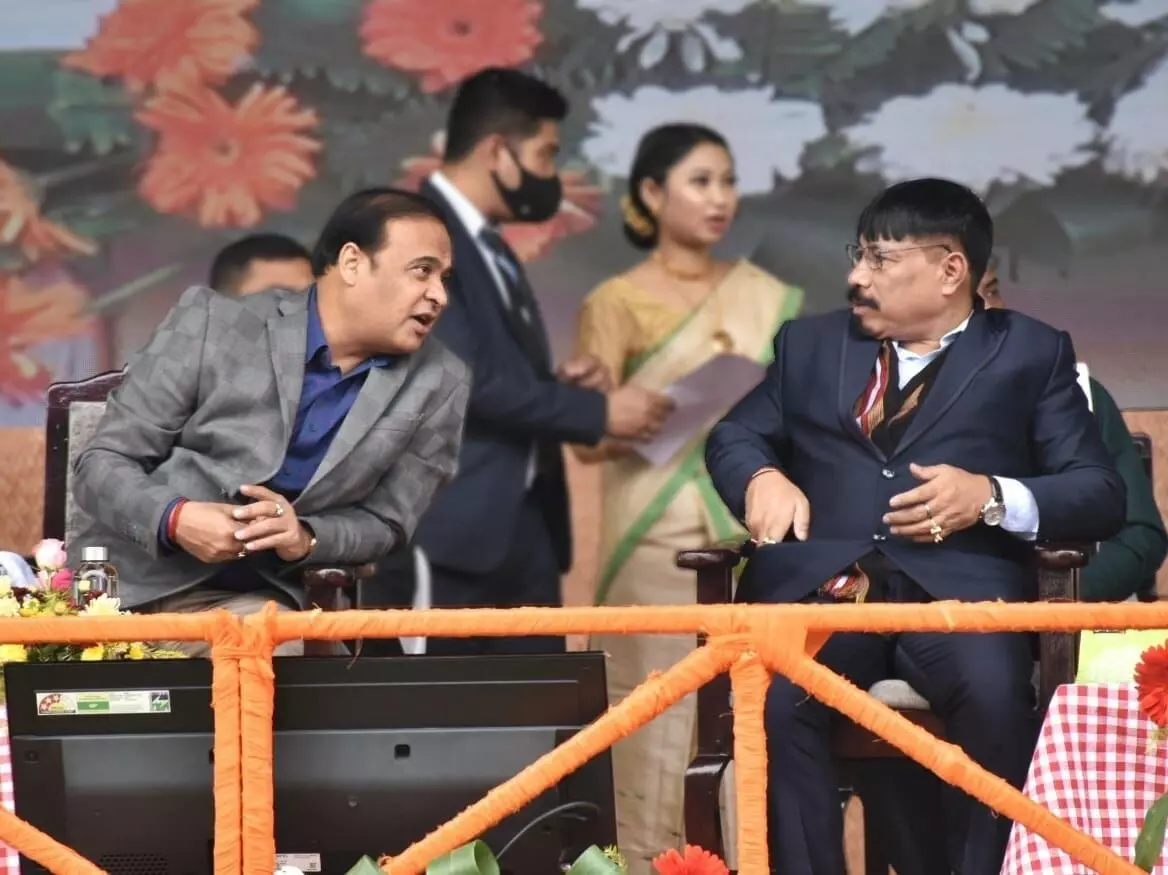
A file image of Assam CM Sarma with Agriculture Minister Atul Bora (right). (Photo:@himantabiswa/X)
Guwahati, March 14: The BJP’s assertion that the NDA seat-sharing formula in Assam is “final” has not entirely settled nerves within its ally Asom Gana Parishad (AGP), where the evolving constituency adjustments have triggered quiet anxiety among ticket aspirants and grassroots leaders ahead of the Assembly elections.
Several constituencies have emerged as politically sensitive in the discussions, including the high-stakes Guwahati Central, Barhampur in Nagaon district, Dergaon and Khumtai in Golaghat district, and Sivasagar, where both alliance partners are believed to have organizational stakes.
At the grassroots level, there has also been speculation around seats such as Palasbari, Sipajhar, Chabua-Lahowal, where local leaders are closely watching the outcome of the seat adjustment.
According to indications from BJP, alliance partners together may contest around 35 seats in the upcoming elections, with AGP expected to field candidates in around 25 constituencies, while BJP contests the majority of the remaining seats.
The ruling party has also hinted that disagreements in a few constituencies could lead to “friendly contests” between alliance partners, reflecting unresolved tension at the local level.
AGP leaders have maintained a cautious public stance so far. Party president Atul Bora has suggested that discussions with BJP were still continuing, indicating that both parties had staked claims over certain constituencies.
However, Chief Minister Himanta Biswa Sarma has maintained that from BJP’s perspective, the seat-sharing arrangement has already been settled and there is little scope for further negotiation.
Behind the scenes, the evolving alliance arithmetic has unsettled sections of the regional party. A senior AGP functionary admitted that negotiations have generated pressure within the organization.
“Some leaders feel that a few constituencies traditionally associated with AGP are under negotiation. The leadership is trying to maintain alliance discipline, but naturally there is pressure from the ground,” the leader said.
Another party source said that the final impact would depend largely on candidate selection. “If the party gets winnable seats, the alliance will remain stable.
But if aspirants feel they are denied tickets because of seat adjustments, friendly contests cannot be ruled out in some constituencies,” the source added.
The uncertainty has already triggered visible churn within AGP. Senior party leader and ticket aspirant Jayanta Khaund recently resigned from the party and joined Congress after his expected constituency reportedly went to BJP, highlighting growing anxiety among aspirants.
Much of the caution within AGP stems from the experience of the 2021 election, when the BJP-AGP alliance also involved significant seat adjustments.
In that election, AGP contested 26 seats and won 9, while the BJP contested the majority of the 126 Assembly constituencies.
During that cycle, several constituencies historically associated with AGP – including Patacharkuchi (now Bajali), Kamalpur, Barhampur, Lakhimpur and Naharkatiya – were contested by BJP under the alliance arrangement.
In exchange, AGP was allotted constituencies such as Chabua-Lahowal, illustrating the shifting balance of power within the coalition.
At present, AGP’s presence in the Assembly includes leaders such as Keshab Mahanta from Kaliabor and Ramendra Narayan Kalita from Gauhati West, while veteran party figure Phani Bhusan Choudhury now represents Barpeta in the Lok Sabha after serving eight consecutive terms as MLA from Bongaigaon.
With the BJP leadership projecting the alliance arithmetic as settled while AGP leaders remain guarded in their public remarks, attention is now shifting to the final distribution of constituencies and candidate selection, which may ultimately determine whether the regional party enters the election with a united front or faces pockets of internal contest within the ruling alliance.