
ECI warns against AI in poll campaign: Why Assam is a test case ?
EC warning gains urgency in Assam, where AI-generated political content already stirs controversy ahead of high-stakes polls
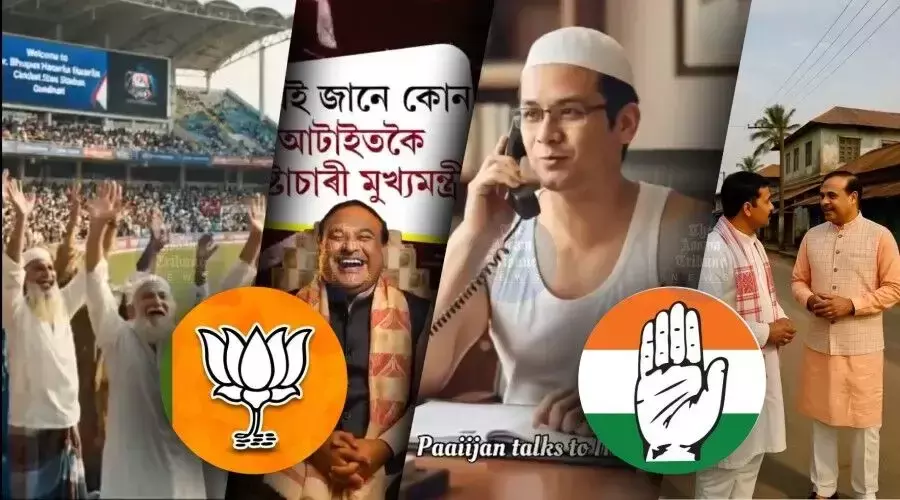
Collage of screengrabs from AI-generated videos circulated by political parties in Assam. (Photo: X & Meta)
As the Election Commission of India (ECI) on Sunday announced the Assembly election schedule for Assam and four other states, Chief Election Commissioner Gyanesh Kumar warned against the misuse of artificial intelligence (AI) and deepfake technology during campaigns.
Addressing a press briefing in New Delhi, Kumar said the Commission had put mechanisms in place to monitor misleading digital content and would take strict action against violations.
“As far as misinformation and deepfakes are concerned, our nodal officers in every state will monitor such cases and take necessary action, including content takedown or filing FIRs where required,” he said in response to a question on the growing use of AI in political campaigns.
Chief Election Commissioner Gyanesh Kumar (centre) with Election Commissioners at Vigyan Bhawan in New Delhi, on Sunday. (Photo:PTI)
Assam AI row
The warning assumes particular significance in Assam, where AI-generated political content has already stirred controversy in the run-up to the high-stakes Assembly polls.
In recent weeks, social media platforms have seen a surge in digitally created political material, with the official handles of both the Assam BJP and the Assam Pradesh Congress Committee sharing AI-assisted videos and graphics.
The issue escalated after an AI-generated video circulated online appeared to show Chief Minister Himanta Biswa Sarma symbolically shooting members of a minority community. The clip triggered outrage and led to a police complaint by the Congress.
Following the backlash, the BJP removed a member of its social media team. The controversy also reached the courts, where petitions were filed challenging the circulation of AI-generated political content.
Parties weigh in
Assam BJP spokesperson Rupam Goswami acknowledged that political communication was undergoing rapid change with the rise of digital platforms.
“There has been a shift already. One barely reads print media today, even television is less watched. My son does not watch television but is updated with every news,” he said.
According to Goswami, AI is merely a tool whose impact depends on how it is used.
“If you create wrong or misinformed content using AI or any other method, it will mislead. It depends on the intention of the individual or party. AI itself is just a tool,” he said, though he admitted that distinguishing between genuine and AI-generated videos has become increasingly difficult.
Congress spokesperson Bandip Dutta warned that AI-driven content could easily mislead voters if not regulated.
“AI-generated content can mislead people in Assam because what matters is the purpose of using such tools. Politics is a serious business,” he said, adding that current AI tools still leave visible errors that attentive viewers may detect.
“But some people may recognise such videos as fake while others may believe them to be real. That is where the danger lies,” Dutta added, calling for stricter legal regulations on the use of AI in political campaigns.
Voters spot AI campaigns
Among voters, the presence of AI-generated political content is already noticeable. Anushriya Mahanta, a 24-year-old student from Guwahati, said she frequently encounters such material on social media.
“I often scroll through Twitter for news updates and I regularly see AI-generated content by political parties,” she said, adding that she tries to spot manipulated videos by looking for inconsistencies such as unnatural blinking or mismatched lip movements.
For her, AI in politics has both benefits and risks. “It’s like two sides of a coin. AI can help spread governance messages widely, but it can also mislead voters because it reaches so many people,” she said.
Another resident, businessman Dilip Hazarika, expressed concern that many viewers might struggle to distinguish between genuine and manipulated content.
“For many people it is difficult to differentiate between real videos and AI-generated ones,” he said, adding that social media often encourages people to believe what they see without verification.
AI regulation gap exposed
Legal experts also pointed out that India currently lacks a dedicated law regulating artificial intelligence. Advocate Anisur Rahman said provisions under the Information Technology Act, 2000 are presently used to address such issues.
“There is no specific AI law in India. However, provisions under the IT Act such as cybercrime under Section 66 or intermediary rules may apply depending on the nature of the offence,” he said.
Rahman added that AI-generated videos could also lead to defamation cases if they falsely portray individuals. “If a video shows a political leader making controversial remarks that were never made, legal remedies are available depending on the impact caused,” he said.
However, he cautioned that such content could threaten social harmony if used irresponsibly. “If someone posts an AI video depicting attacks on a community or religious site, it could easily trigger unrest,” Rahman said, suggesting restrictions on AI-generated political content until clearer regulations are framed.
Despite the controversy, political parties appear unlikely to abandon AI-driven communication anytime soon. Goswami described the technology as an inevitable part of modern campaigning.
“If we do not adopt new technologies, we will become outdated. Today even poor sections of society use smartphones. AI is becoming unavoidable,” he said.
Observers note that the growing use of memes, simulated videos and digital narratives reflects a broader transformation in political campaigning, raising new challenges for regulators seeking to balance technological innovation with electoral integrity.
With inputs from IANS